Bird Flu Strikes America’s Largest Egg Producer: A Wake-Up Call for Global Poultry Health
The planned culling of 1.8 million birds at a major US egg production facility highlights the continuing threat of avian influenza and the urgent need for stronger, more sustainable disease prevention strategies.
· 5 min read
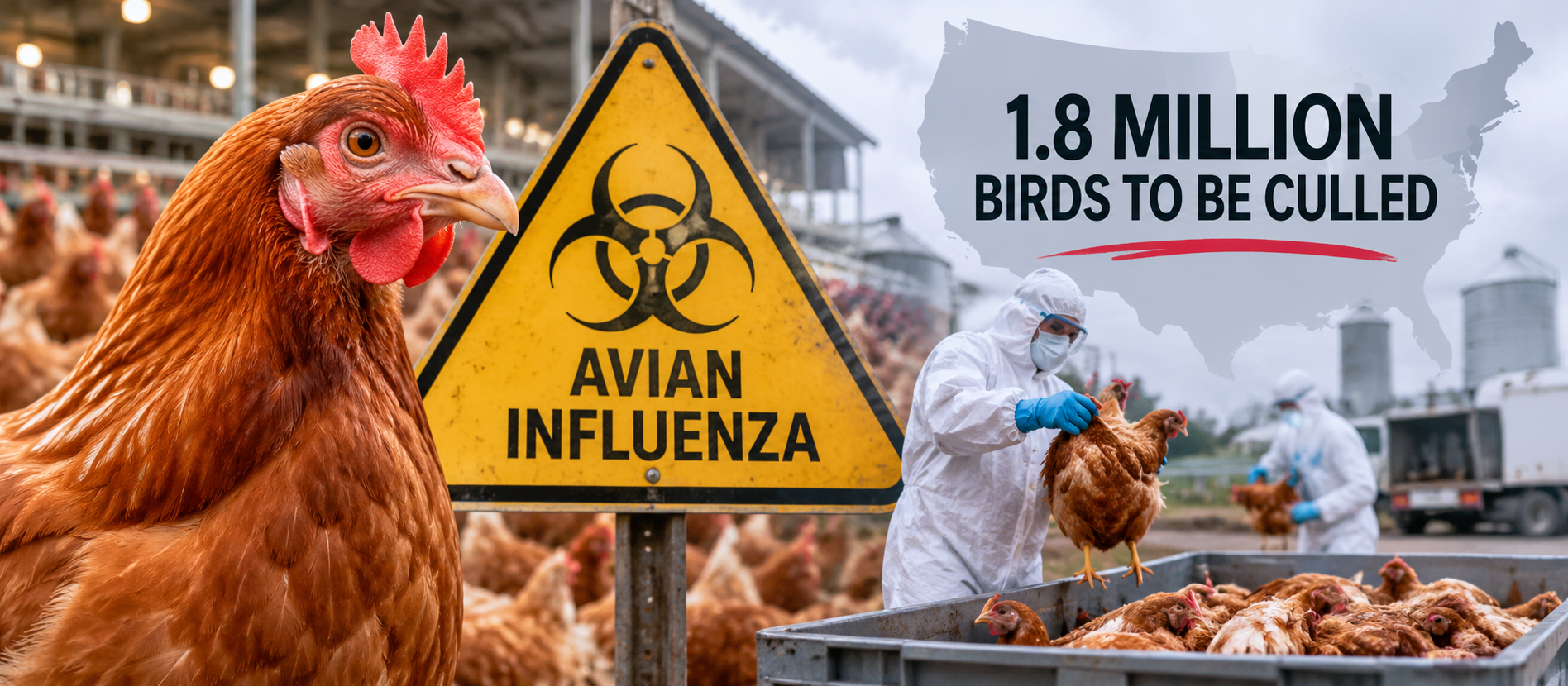
The announcement, reported by Al Jazeera on 18 November 2026, includes the culling of approximately 1.4 million laying hens and 360,000 young hens (pullets). Together, these birds represent around 2.7% of the company's total flock. Production at the affected facility is being temporarily suspended as the company implements disease-control measures.
While the immediate response is focused on containing the outbreak, the incident highlights a much wider challenge facing the global poultry industry: how to protect animal populations, safeguard food supplies and maintain production in the face of persistent infectious disease threats.
A significant blow to US egg production
Cal-Maine Foods has confirmed that it will coordinate with its other production and distribution facilities to minimise disruption to customers and maintain continuity of supply.
However, the scale of the planned culling demonstrates the considerable operational and economic consequences that a single outbreak can have, even for a large and geographically diversified producer.
This is not an isolated incident. According to the figures reported by Al Jazeera, approximately 21.5 million birds have been affected by avian influenza in the United States during 2026.
The impact has been particularly severe for the egg industry. Between October 2024 and March 2025, approximately 50.7 million laying hens were lost, contributing to significant supply shortages and pushing US egg prices to a record average of $6.23 per dozen.
Although prices have since fallen, the latest outbreak demonstrates that the underlying threat has not disappeared.
Avian influenza: More than an animal health issue
Highly pathogenic avian influenza is not simply a veterinary concern. Its consequences extend across the entire poultry value chain, affecting producers, workers, consumers, food retailers and international trade.
Large-scale outbreaks can result in:
Significant poultry mortality and the loss of productive breeding and laying stock.
Increased costs associated with disease surveillance, testing, containment and disposal.
Disruption to egg and poultry supply chains.
Market instability and price fluctuations.
Reduced confidence in the resilience of poultry production systems.
The human health implications also require continued monitoring. Al Jazeera reports that the US Centers for Disease Control and Prevention (CDC) has recorded 74 human cases since February 2024, with no evidence of human-to-human transmission reported in the figures cited.
Although the risk to the general public is considered low, the situation reinforces the importance of a coordinated One Health approach, recognising the interconnected health of animals, humans and the environment.
Why biosecurity must remain a priority
The Cal-Maine outbreak is a reminder that no poultry production system can afford to become complacent.
Effective biosecurity remains one of the most important tools available to prevent the introduction and spread of avian influenza. This requires a comprehensive approach that includes:
Strict controls over access to poultry facilities.
Effective cleaning and disinfection protocols.
Regular monitoring and early detection of disease.
Appropriate management of equipment, vehicles and personnel.
Measures to reduce contact between domestic poultry and wild birds.
Rapid reporting, diagnosis and implementation of veterinary control measures.
Importantly, biosecurity should not be viewed as a one-off investment or a checklist of procedures. It must be embedded into everyday farm management, supported by staff training, veterinary oversight and continuous assessment of potential risks.
Moving beyond reactive disease management
The repeated emergence of avian influenza outbreaks raises an important question for the poultry sector: is relying primarily on reactive disease-control measures sufficient to protect production systems in the long term?
Culling infected and exposed birds can form an essential part of official outbreak-control strategies. However, the continuing scale and recurrence of outbreaks demonstrate the need to strengthen preventative approaches alongside established control measures.
Research, improved surveillance, diagnostic innovation and the development of effective vaccination strategies all have a role to play.
Vaccination, where authorised and appropriately implemented within national disease-control frameworks, could provide an additional layer of protection. It must, however, be supported by robust surveillance, appropriate vaccine selection, monitoring of vaccine effectiveness and continued biosecurity.
The objective should be to develop integrated disease-management strategies that reduce the likelihood of outbreaks, limit their consequences and improve the long-term sustainability of poultry production.
A global challenge requiring collective action
Although this latest outbreak has occurred in the United States, its implications extend far beyond the country's borders.
Avian influenza is an international animal health challenge that requires collaboration between veterinary authorities, researchers, producers, diagnostic laboratories and policymakers.
The poultry industry needs to prioritise preparedness rather than simply responding once an outbreak has occurred. Investment in research, improved disease monitoring, knowledge exchange and practical farm-level prevention will be essential to building more resilient production systems.
For the industry, the message is clear: protecting poultry health is fundamental to protecting food security.
INAH's perspective
At INAH, we recognise that the continuing threat of avian influenza demands a proactive, science-led and collaborative approach to animal health.
The latest developments in the United States demonstrate why disease prevention, early detection and effective control strategies must remain central priorities for poultry producers and the wider animal health community.
The future resilience of the poultry sector will depend not only on how effectively outbreaks are contained but also on how successfully the industry invests in preventing them.
The challenge is no longer simply responding to avian influenza. It is building poultry production systems that are better equipped to withstand it.