Avian Influenza Beyond Birds: New Evidence of Virus Exposure in Livestock in Egypt
New research from Egypt highlights the potential spillover of avian influenza viruses into cattle, sheep and goats, reinforcing the need for integrated surveillance across poultry, livestock and wildlife.
· 6 min read
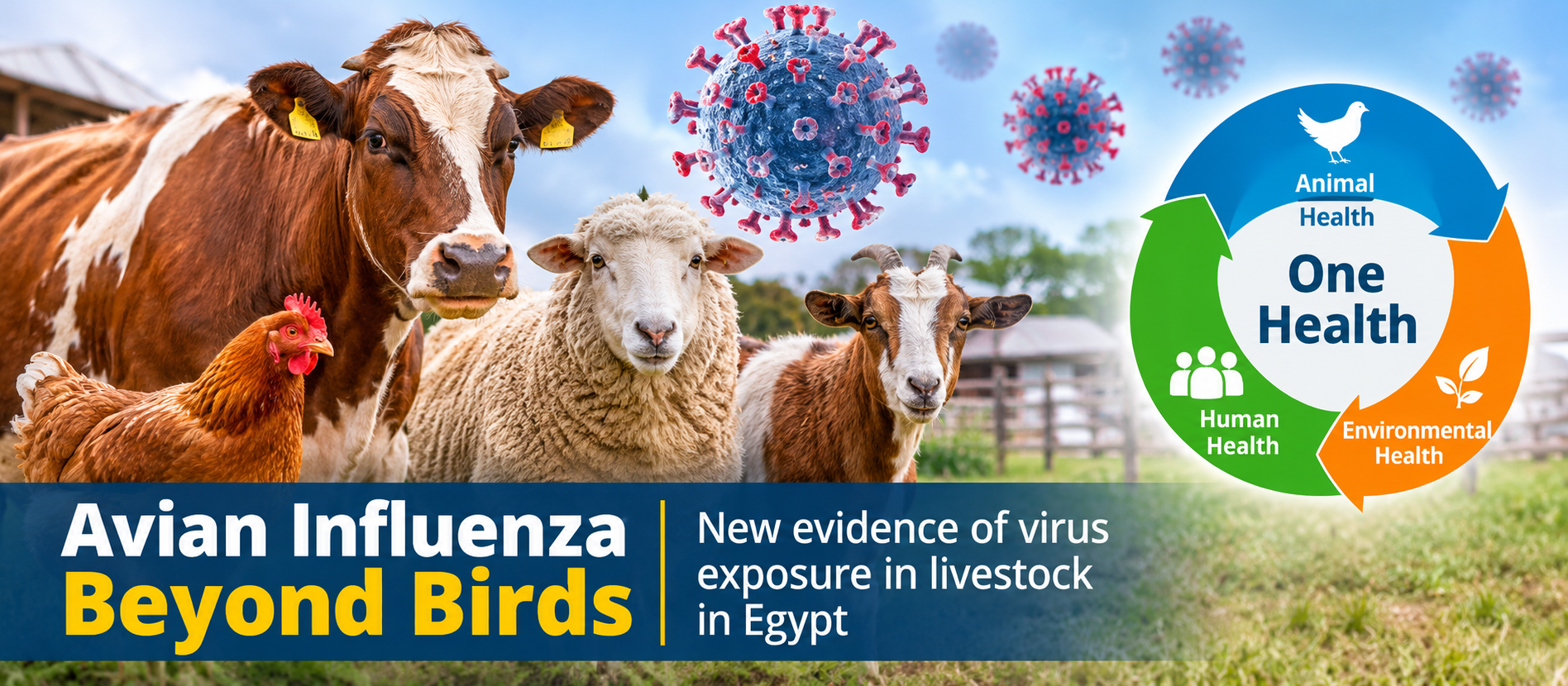
Avian influenza is no longer just a disease of birds. As the global spread of highly pathogenic avian influenza (HPAI) H5N1 continues to challenge animal and public health systems, increasing attention is being paid to its ability to cross species barriers and infect mammals.
A new study published in the US Centers for Disease Control and Prevention's journal Emerging Infectious Diseases provides further evidence of this concern. Researchers investigated whether avian influenza viruses circulating in Egyptian poultry populations were also spilling over into domestic livestock. Their findings suggest that exposure to both H5N1 and H9N2 avian influenza viruses is occurring in livestock in northern Egypt.
What did the researchers investigate?
Egypt has experienced sustained circulation of avian influenza viruses, including highly pathogenic H5N1 and low pathogenicity H9N2, in commercial poultry farms, backyard flocks and live bird markets.
Given the close contact between poultry and livestock in many traditional farming systems, researchers sought to establish whether these viruses were also crossing into other domestic animal species.
Between October 2024 and January 2026, the research team collected 444 blood serum samples from animals on 33 small farms and backyard holdings across three governorates in northern Egypt.
The samples came primarily from cattle, alongside sheep and goats kept in mixed-species backyard settings. The researchers tested for antibodies against H5N1 and H9N2 avian influenza viruses to investigate evidence of previous exposure.
What did they find?
The results provide important evidence of avian influenza exposure in livestock.
Of the 444 serum samples tested:
H5N1 antibodies: 4.5% of samples tested positive using the haemagglutination inhibition (HI) assay, while 2.9% were positive using the microneutralisation (MN) assay.
H9N2 antibodies: 2.5% of samples tested positive.
Importantly, the findings were not restricted to cattle.
All animals with detectable H5N1 antibodies were cattle. However, H9N2 antibodies were identified in cattle, sheep and goats. The highest proportion of H9N2-positive samples was found in sheep (10.3%), followed by goats (3.2%) and cattle (1.6%).
The researchers also identified geographical differences in antibody detection, suggesting that exposure may vary between locations.
Interestingly, the presence of other animal species on the holdings was not significantly associated with seropositivity. Small farms, however, had a significantly higher proportion of H5N1-positive cattle when assessed using the microneutralisation assay.
Taken together, these findings suggest that exposure to avian influenza viruses is not confined to poultry and that multiple livestock species may be involved in the wider epidemiology of these viruses.
Why do these findings matter?
The detection of H5N1 antibodies in cattle is particularly noteworthy in the context of the H5N1 outbreaks in dairy cattle in the United States during 2024.
Those outbreaks demonstrated that H5N1 can establish infection in a mammalian livestock species, with the virus showing a particular affinity for mammary tissue and being detected at high concentrations in milk. Transmission between cattle has also been associated with milking practices.
The Egyptian study adds an important geographical dimension to this emerging picture. It suggests that livestock exposure to avian influenza viruses may also be occurring in regions where H5N1 is already endemic in poultry.
The detection of H9N2 antibodies in sheep and goats is equally relevant. Although H9N2 is generally considered a low pathogenicity avian influenza virus in birds, its circulation and evolution warrant continued attention because of its potential to contribute genetic material to emerging influenza viruses.
These findings reinforce the importance of understanding avian influenza as a multi-species health challenge rather than a disease confined to poultry production.
Important questions remain
Although the findings provide evidence of previous exposure to avian influenza viruses, the researchers emphasise that serological evidence alone cannot confirm active infection.
The study did not establish when exposure occurred, whether the animals had experienced clinical disease, or how transmission might have taken place. It also remains unclear whether livestock could contribute to onward transmission or act as hosts in which viral adaptation or reassortment might occur.
Further investigation is therefore essential to understand the epidemiological significance of these findings.
In particular, future studies should investigate:
Whether H5N1 and H9N2 infections can be confirmed through virus detection and genomic sequencing in livestock.
The frequency and duration of infection in cattle, sheep and goats.
Potential transmission pathways between poultry and livestock, particularly in mixed-species farming systems.
Whether livestock infections are associated with clinical signs, milk production or other indicators of animal health.
The potential occupational exposure risks for farmers, veterinarians, farm workers and others in close contact with affected animals.
A One Health approach is essential
The findings from Egypt highlight the importance of strengthening surveillance at the interfaces between poultry, livestock, wildlife and people.
In many parts of the world, particularly where backyard poultry keeping and small-scale livestock production are common, different animal species share housing, feeding areas and water sources. These interactions can create opportunities for pathogens to cross species barriers.
Surveillance systems that focus exclusively on poultry may therefore miss important epidemiological developments occurring in other animal populations.
An integrated One Health approach should bring together veterinary services, animal health researchers, public health authorities and farmers to improve early detection, information sharing and coordinated responses.
This includes expanding avian influenza surveillance to livestock in areas where the virus is endemic in poultry, investigating unexplained illness or production losses in mammals, and strengthening biosecurity practices on mixed-species farms.
The bigger picture
The study, Serologic Evidence of Avian Influenza Virus Exposure in Livestock, Egypt, 2024–2026, provides another reminder of the changing epidemiology of avian influenza.
Although further research is needed to confirm infection and understand the implications for transmission, the detection of H5N1 and H9N2 antibodies in livestock highlights the need to look beyond birds when monitoring avian influenza.
For the international avian health community, the message is clear: protecting poultry health requires understanding what is happening across the wider animal population.
Strengthening surveillance, improving biosecurity and fostering collaboration across animal and human health sectors will be essential to identifying emerging threats and reducing the risk of future influenza outbreaks.
Source: Gomaa M, El-Shesheny R, El Taweel A, et al. Serologic Evidence of Avian Influenza Virus Exposure in Livestock, Egypt, 2024–2026. Emerging Infectious Diseases. 2026. DOI: 10.3201/eid3212.260869.
Prepared for the International Network for Avian Health (INAH).